
Welcome to our Knowledge Base
Governing Temporary Traffic Management: A Strategic Guide for Directors and Senior Leaders
Prefer a PDF? Download a digital copy of this guide here: Download link
Foreword: This Isn’t About Cones, It’s About Decisions
For years, Temporary Traffic Management (TTM) in New Zealand has been governed by a rulebook. The Code of Practice (CoPTTM) gave us diagrams to follow, and governance was often reduced to a simple, compliance-based question: “Did we follow the rules?”
That era is over.
NZ is replacing prescriptive TTM with a risk-based system. This does not change legal duties, but it does change how officers and leaders gain confidence that work in the road corridor is planned and delivered to achieve the lowest total risk.
Under NZ’s Health and Safety at Work Act 2015 (HSWA), Persons Conducting a Business or Undertaking (PCBUs) must eliminate risks or, if elimination is not reasonably practicable, minimise them so far as is reasonably practicable. Officers must exercise due diligence. In a prescriptive era, leaders often equated compliance with safety. That shortcut is woefully incomplete. NZGTTM expects decisions to be based on the specific risks associated with the activity and location, and for controls to be chosen because they reduce the total risk for workers and road users. The public expects the same, and they expect disruption and cost to be justified.
This guide is written for governors and senior managers who want practical direction. It explains what to ask for, what good looks like, and how to check that decisions align with the organisation’s risk appetite. It also addresses incentives and commercial models, because how an organisation pays influences how people behave. The aim is simple: Use exactly the right amount of TTM by making better decisions about the work and the controls.
This guide provides the mechanism to achieve better safety while also unlocking efficiency, reducing cost, and rebuilding public trust.
A standard, outdated governance question was: “Is our TTM system compliant?”
A more appropriate governance question is: “How are we demonstrating that our TTM system manages risk?”
This guide is structured to provide a framework for asking the right questions, setting the right strategy, and obtaining the right assurance. It moves from the foundations to the principles and behaviours, providing practical, tangible actions surrounding Temporary Traffic Management (TTM).
A ‘starter for ten’ – some simple actions
You can separarate this first section as a stand-alone quick start guide.
We understand this guide is long, so if time is not on your side and you want the ‘quick version’ here are a series of ‘starters for ten’ to activate this guidance in lieu of digesting the full document end-to-end.
Five potential questions for your next Board meeting
Disclaimer: the following questions are examples only but give a flavour of the types of TTM-specific questions directors can be asking. These questions would change based on the organisational configuration and relationship to TTM.

Domain
Success criteria and evidence
- The overlapping duties across client, prime, RCA, TTM designer, and TTM provider are clear.
- The 3Cs are a routine cadence at concept, approval, change, and close-out.
- Evidence to ask for: RASCI, coordination minutes, a live escalation pathway that is used in practice.
- Contract variations require NZGTTM-aligned risk-based outcomes.
- TTM pricing is integrated with work method and risk exposure, not treated as a fixed line item.
- Procurement scores risk-based capability and evidence, not just rates.
- Evidence to ask for: signed variations, evaluation records, pricing models that move with method and risk.
- Role-based competence replaces NZTA ‘warrants’ as the primary assurance.
- Supervision tests decision quality in the field.
- Officer capability and access to independent advice are in place per IoD foundations.
- Evidence to ask for: competence matrices, supervision notes that critique decisions, recent external advice.
- Design and planning apply multiple risk techniques where needed.
- Controls are chosen because they reduce defined risks in context.
- Practices are updated based on outcome evidence.
- Evidence to ask for: method comparisons, performance studies, retired controls list.
- TMPs are built from the ground up.
- Each control links to a hazard pathway and a reason.
- Prevention through Design options are recorded.
- Evidence to ask for: annotated TMPs, design review minutes that show trade-offs.
- Pre-starts check assumptions.
- Deviations are recorded with the revised risk reasoning and sent back to the designer.
- Low-value controls (or ones that demonstrate no risk reduction) are reviewed and reconsidered.
- Evidence to ask for: change logs, photos tied to the risk rationale, exposure hour summaries.
- Audits test control effectiveness, not just presence.
- Reports triangulate documents, observation, and performance data.
- Board reporting focuses on insight rather than counts. This aligns with IoD guidance to shift from lag indicators to information that shows whether work can be done safely.
- Evidence to ask for: audit findings linked to specific controls, trend reports that show learning and change.
[1] Controls that were considered, but ultimately not used (i.e. for not being ‘reasonably practicable’) are recorded. This is an excellent way to demonstrate the process of decision making, especially in line with the hierarchy of controls, is working.
[2] This refers to designing out the risk as part of the work methodology configuration. Preventing TTM risk by it not materialising in the first place through good work design is a form of elimination and should be recorded.
Example Officer prompts related to TTM
Leveraging the Institute of Directors (IoD) Health and Safety Governance Guidance 5C’s:

Courage
When did the board last say “we do not know” about a TTM risk and seek independent advice? Use the quick guide’s emphasis on constructive challenge.

Capability
What personal learning in TTM risk and control effectiveness has each officer completed this quarter? Use the self-assessment to plan learning.

Curiosity
What are workers telling us about where work as done deviates from plan6, and what changed because of that? Use the quick guide’s prompts on genuine worker voice and effectiveness of systems.

Context
Who sits in our ecosystem with overlapping duties on this job 8and how are we coordinating? See the quick guide context questions.

Care
How did the organisation respond to bad news last month? Do people feel safe raising weak signals? See the quick guide’s focus on tone and trust.

Board actions
- Adopt a TTM governance position aligned to IoD due diligence areas.
- Confirm officer induction on the new philosophy of TTM and access to competent advice.
- Commission a baseline review against the seven domains (listed in Table 1). Approve target dates for at least three initial milestones of transition.
- Set an assurance calendar focused on critical TTM risks and how they are controlled.
- Ask for an example of how TTM controls are selected (from risk origin to treatment) as evidence of effective risk management process being applied in practice.
- Conduct personal due diligence on these critical risks to satisfy yourself that the reported controls are effective in reality, rather than relying solely on system reports.

Senior manager actions
- Draft a short TTM appetite note that teams can use in TTM-related decisions.
- Separate TTM design from supply on at least one pilot, or put in place conflict controls and extra verification. Measure the difference in TTM quantity and performance.
- Build a role-based competence matrix for TTM planners, designers, and site leaders. Plan supervision that tests decisions on site.
About this guide
Scope
- Risk-based governance of temporary traffic management across concept, design, approval, delivery, change, and review.
- The organisational levers Boards and executives control: roles and decision rights, appetite statements, procurement and incentives, competence, and assurance.
- What to measure and how to learn.
This is not a technical manual for TTM, nor does it contain detailed procurement templates or contractual material. This is a governance guide of how to make appropriate decisions in those domains.
Icons and panels used throughout
To help readers digest important information relevant for them, the following icons represent key themes through this guide

Important terminology and language
- Lowest total risk means the chosen mix of work method and controls reduces net risk across workers and road users more than any other reasonably practicable option.
- ALARP (or SFARP) refers to the HSWA standard of managing risk so far as is reasonably practicable.
- The 3Cs are the HSWA duties to consult, cooperate and coordinate where duties overlap.
- Prevention through Design (PtD) is the discipline of changing the work so the hazard is removed, or people are no longer exposed to it. In TTM this means starting with the job, not the cones.
- Typical PtD moves include: alter the method to avoid live traffic exposure, shift time to low demand windows, relocate off the carriageway, prefabricate or pre-assemble off site, use trenchless or remote techniques, sequence for short, complete closures instead of prolonged shoulder work, and design physical separations that remove the need for lower-order controls. Only after feasible PtD options have been tried and recorded should the team rely on administrative controls and signage.
Governance positions adopted in this guide
A powerful guide for governance of Health and Safety in New Zealand is published by the Institute of Directors (NZ) (IoD). This TTM-specific governance guide draws from several of the principles and guidance provided by the IoD and you will see those references throughout this document.
The following more specific philosophical positions are taken across this document as a basis for guidance:
- Compliance is not a proxy for safety. Boards need evidence that decisions are reasoned from risk, not from templates.
- [Risk] appetite guides acceptance after treatment. Appetite is not a substitute for treatment.
- Separate TTM design from supply where TTM is subcontracted. If not separated, install strong conflict controls and verify them.
- Incentives matter. Contracts must pay for outcomes that match value and objectives.
- Competence is owned by the employer PCBU. Credentials and courses are inputs, not evidence of competence in context.
- Assurance must check effectiveness. Reports should help officers understand whether the conditions for safe work exist and are maintained, as advised in IoD guidance.
Part A: Duties, decisions, and the end of “compliance” as a defence
The end of “compliance” as a defence
HSWA has always set the duty: PCBUs must eliminate risks, or if elimination is not reasonably practicable, minimise them so far as is reasonably practicable.
Officers must exercise due diligence.
CoPTTM fostered a belief adherence to that standard meant the duty was met. That belief was never safe. It shifted attention away from site-specific risk and from the Officer’s personal obligation to be satisfied the organisation has the right knowledge, systems, resources, information flows, and verification in place.
The Institute of Directors’ material is unambiguous: officers are expected to build knowledge, understand operations and the risk profile, ensure resources and systems, ensure information reaches the top and is acted on, and verify effectiveness through personal due diligence. Those six areas should be treated as the backbone of TTM governance and reporting.
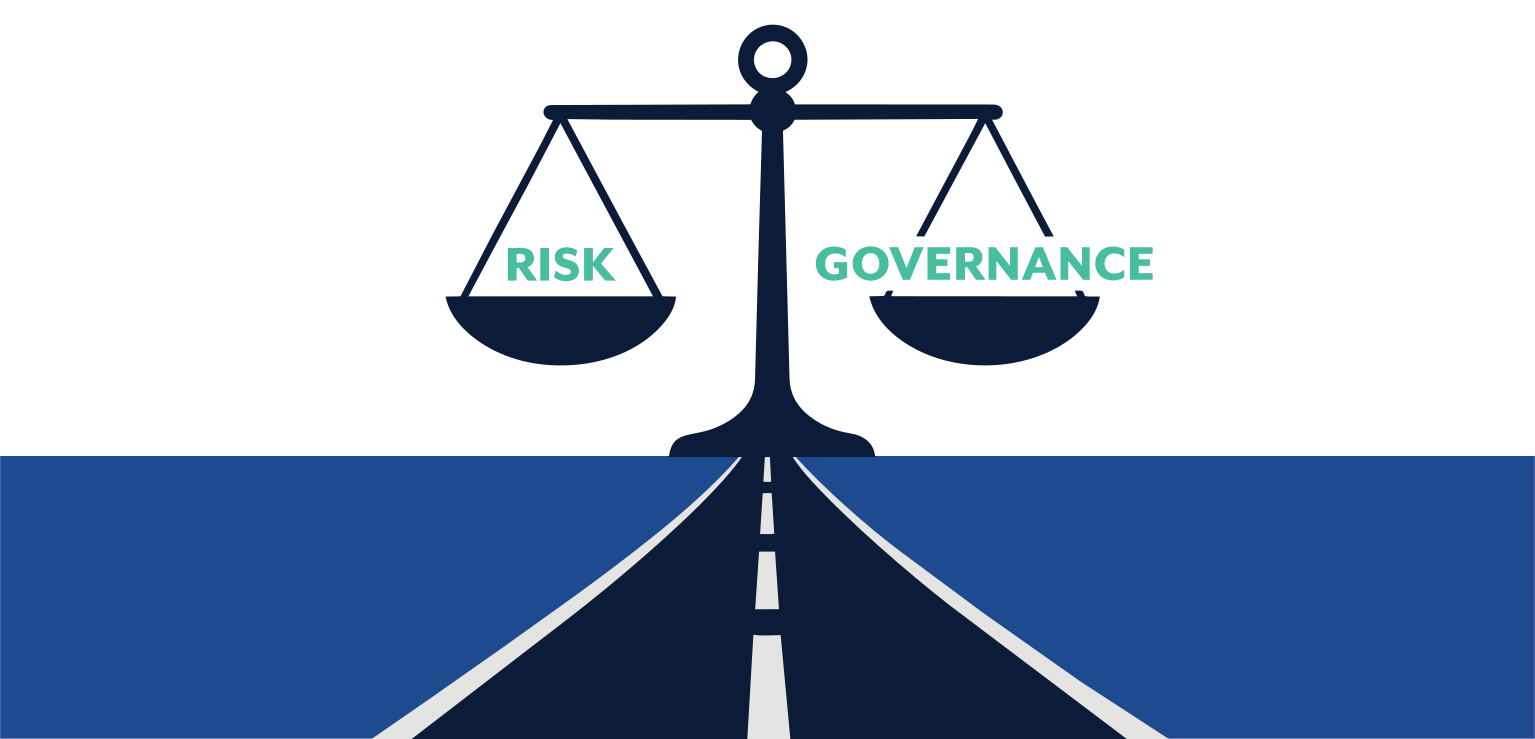
Regarding TTM, boards should not be asking “are we compliant”. They need to see evidence that thinking across the organisation is occurring that links the hazards of the work and place to the chosen configuration, and why that configuration gives the lowest total risk for workers and road users.
What risk-based TTM means for governance
Risk-based TTM is not a code word for using fewer cones. It means using the right controls for the risks that actually exist. Every sign, barrier, cone, temporary speed limit and attenuator truck must be purpose-tied to a risk pathway.
Confidence that the organisation has done what is reasonably practicable comes from the quality of the process, not the thickness of the plan: hazards identified, Prevention through Design exhausted, feasible options compared, reasons recorded, and a simple plan for how decisions will be reviewed when conditions change.
There is a sweet spot.
- Too little treatment leaves risk above ALARP and will not stand up to scrutiny and may result in harm.
- Too much treatment adds unnecessary worker exposure for installation and removal, driver confusion, and disruption that does not reduce net risk (and adds waste and cost).
The job of governance is to insist the team finds and demonstrates that sweet spot can be found systemically through good processes and capability across the organisation and supply chain.

The central governance challenge: balancing competing objectives
Absolute safety is not available. Every job carries residual risk after treatment. Each day, the organisation accepts a level of residual risk to achieve project progress and keep the network functioning. Pretending otherwise pushes decisions underground.
Good governance makes the trade-off deliberate. It requires the organistion to state what residual risk remains, why further reduction is not reasonably practicable, and how that acceptance lines up with the organisation’s risk appetite. That is the difference between unspoken compromise and a defensible decision grounded in appetite that has been translated into clear, management-level choices.
Every roadwork site is a three-way trade-off:
- Safety: Lowering exposure and crash severity risk to ALARP.
- Project achievement: Finishing the work so the asset delivers value.
- Network utility: Keeping the network functioning for people and freight.
A full closure during the day may be best for safety and programme yet poor for the network. The Officer’s role is not to instruct the preferred option, but to set the strategy and appetite that guide those trade-offs and to require transparent reasoning when objectives clash.
Risk appetite is the tool that declares how much project or network pain the organisation will accept to meet safety outcomes.

Governance in action
- What objectives were in tension, and how were they weighed.
- Which options were feasible after Prevention through Design was considered, and why the preferred option gives the lowest total risk.
- What assumptions would trigger a rethink, and how will that be checked in the field.
The IoD guidance helps officers hold these conversations well. Its foundations, principles and 5Cs can be used to shape agendas: learn and develop, anticipate and understand, plan and resource, trust and verify, monitor and respond, model courage, capability, curiosity, context and care.
What a sound TTM decision looks like
A decision that would withstand scrutiny has four features:

This is consistent with IoD’s call for reports that help officers understand whether the conditions for safe work exist, whether critical controls are effective, and how the organisation learns when reality differs from plan.
What the Board should expect to see
Boards should not be fed data that says little about whether work can be done safely. They should ask for concise information that matches IoD expectations and supports decisions: a short narrative of the risk reasoning for high-complexity activity, field verification of a small set of critical controls, what changed after assurance, and the unresolved uncertainties that need further checking.
Directors should complement this reporting with personal verification, such as site visits, to see how work is actually done and validate that reality matches the paperwork.
Expect a plain record of any residual risk the organisation is accepting and why that acceptance aligns with its established appetite.
Senior Manager Actions
- Planning learning visits to understand work-as-done .
- Scheduling a periodic deep dive on a critical TTM risk.
- Seeking one independent perspective each quarter.
- Using the IoD self-assessment to review personal practice against the 5Cs and adjust agendas accordingly.
Part B. The Governance Architecture: Roles and Responsibilities
A Governance Model for TTM Decisions
To govern the risk-based approach defined in Part A, organisations must establish a clear architecture for making, challenging, and verifying TTM decisions. In a risk-based world, the quality of outcomes rests on the quality of decisions. Governance fails when decision rights are blurred or accountability is vague.
The Board’s role is to approve this architecture. The “Three Lines Model,” common in risk management, is one way to structure accountability.
- First Line: Management (Owns the Risk) This is the project or operational management team (e.g., the Prime Contractor). They are responsible for executing the work and own the TTM decision. They must balance the three competing objectives (Safety, Project Achievement, Network Utility) and select the final, lowest-total-risk approach.
- Second Line: Risk & Support (Sets the Framework) This is the organisation’s internal specialist function (e.g., H&S team, TTM Principal, Risk Manager). They support the First Line by providing the tools, standards, and competent advice. Crucially, they also challenge the First Line’s decisions, ensuring the risk process was followed and appetite was applied correctly.
- Third Line: Assurance (Provides Verification) This is the independent assurance function (e.g., internal audit, independent reviewers). They verify that the entire system (Lines 1 and 2) is working effectively. They report directly to the Board or a committee, providing an objective view on whether critical controls are effective in practice.
Decision Rights When Conditions Change
A TTM plan is a hypothesis. It will be wrong the moment it hits the road. Weather, traffic, or on-site discoveries will require change. The governance model must define decision rights for when the plan deviates from reality.
- Who can make on-site adjustments?
- What triggers a formal “stop and redesign”?
- What is the live feedback loop back to the TTM designer?

Governing body and officers (oversight and risk appetite)
- Set risk appetite statements that can be applied to and are relevant for TTM (test risk appetite statements against the domain of TTM and ensure they are compatible).
- Require evidence that lowest total risk has been sought and achieved for both workers and road users.
- Mandate Prevention through Design (PtD) options are exhausted before administrative controls are relied on.
- Periodically verify, through personal observation or independent review, that these expectations are met in practice.

Management, first and second line (delivery and risk support)
- First line owns the work method and integrates TTM into the method.
- Second line sets the risk process, tools and training, assures that NZGTTM elements and practice notes are in use, and convenes the 3Cs.

Third line (independent assurance)
-
Internal audit, client audit or alliance assurance independently verifies that controls are evidenced, effective and adapted when conditions change. Use outcome-focused audits that correlate incidents and near misses to specific controls.

Evidence to ask for
- The formal structures around TTM decision making, clearly showing who holds the roles/rights for the Three Lines.
- A RASCI (Responsible, Accountable, Supportive, Consulted, Informed) matrix that clarifies decision rights at a strategic level (see Appendix D for a governance-level example) and is supported by more detailed operational RASCIs for project-level roles.
- The protocol or coordination plan that makes the 3Cs a routine, scheduled ritual for projects.
Governing Competence: Owning the PCBU Duty
Relying on “tickets” or “warrants” (as has historically been the case) as the sole evidence of competence is not a defensible governance position. The legal duty under HSWA rests with the PCBU to ensure its people are competent for the specific tasks they perform, in the context of the work.
The Board’s role is to seek assurance that a robust competence system exists, one that the organisation owns and controls.
- Competence vs. Credentials. Credentials (like warrants or courses) are an input to competence, not proof of it.
- Competence in Context. True competence is the verified ability to apply skill and knowledge to make sound risk-based decisions in the field, not just in a classroom.
- Governing Roles. Governance should focus on assurance for the critical decision-making roles—such as the TTM designer, the reviewer, the on-site leader, and the auditor.
Board actions
- Adopt a systemic approach establishing role-based competence (and expiring historical warrant-based assurance) for all TTM decision-making roles.
- Require credible TTM competence reporting at the Board level. This report should describe: (i) the critical TTM decision roles; (ii).the specific skills required for those roles; (iii) how those skills are verified in context (e.g., portfolio reviews, on-site supervision checks); and (iv) where gaps exist and how they are being managed deliberately.
- Verify this competence personally by interacting with key decision-makers (e.g. designers or site supervisors) to test their understanding of the risk-based approach.
Evidence to ask for
- A Role-Based Competence Matrix for TTM.
- Supervision notes or audit reports that critique the quality of decisions, not just the presence of a “ticket.”
Part C. The Decision Framework: Appetite, PtD, and Assurance
Setting and Using Risk Appetite
A common governance failure is to misuse risk appetite. It is not an excuse to skip reasonably practicable controls. Its correct function is to guide the acceptance of residual risk—the risk that remains after all reasonably practicable steps to eliminate or minimise have been taken.
In TTM, this is critical for guiding management on how to transparently and consistently balance the three competing objectives (Safety, Project Achievement, and Network Utility) introduced in Part A.
A high-level corporate statement is insufficient. The appetite statements must translate to practical application and be supported by clear direction that project teams can use to make defensible decisions.
Senior manager actions
- Publish some form of short, applied TTM Risk Appetite Note for use operationally.
- This should cover the organisation’s specific stance on various TTM-related risk domains such as:
-
-
- Selecting closures and TTM methodologies, like full closures vs. retention of live traffic vs. working in the gaps (and other variations).
- The approach to decisions about duration. The trade-off between a short, highly disruptive project and a long, low-impact one.
- Thresholds. Clear escalation triggers for when a TTM decision’s impact (e.g., on cost or network delay, or potential residual safety risk) is significant enough to require executive-level consultation.
-
The ALARP Test: A Defensible Decision Process
For Officers to gain confidence and meet due diligence duties, they need to rely on a repeatable, robust process. This is the definitive test to ensure a decision is defensible and that the ALARP standard was met.
One method of assurance is this 6-step process for all TTM activities:
- Prevention through Design (PtD) is recorded. All feasible options to eliminate or substitute the hazard (e.g., change of work method, time, or location) were identified and evaluated first. The reasons for rejecting them are documented.
- Site-specific risk analysis. The specific risk pathways for this site and this work were analysed, moving beyond generic templates.
- Options analysis. The selected mix of controls was demonstrably shown to achieve the lowest total risk compared to other feasible options.
- Residual risk is named. The remaining risks (after all controls are applied) are explicitly stated, and accountability for accepting them is assigned. These are demonstrably below the level of acceptable risk identified through the operationalisation of the Board’s risk appetite.
- Field deviations are logged. A live process exists to capture changes in the field (where work-as-done differs from work-as-imagined) and to feed this back to the designer for a revised risk assessment.
- Post-work review. A learning loop exists to confirm whether an alternative approach would have been reasonably practicable in hindsight, with lessons fed into future designs.
Evidence to ask for
- A summary of the TTM decision rationale (see Appendix D for an example of a Governor’s Summary) for high-impact projects. This summary should confirm a robust ALARP process was followed and justify the accepted trade-offs.
- This rationale could be a narrative record showing the six items above. A simple checklist is insufficient. It is the documented proof of the decision-making process.
Part D. The Enablers: Commercials, Contracts, and Reporting
The First Commercial Guardrail: Decouple Design from Delivery
How an organisation pays for TTM is a powerful driver of behaviour. Governance of TTM risk is incomplete without governance of its commercial incentives.
A fundamental conflict of interest exists when the party paid by the volume of TTM is also the party deciding the volume of TTM. This model financially incentivises waste and “cone mania,” not risk management.
Note: This does not include where TTM is self-performed within an organisation. The conflict of interest materialises where a sub-contractor is commissioned to decide themselves on the quantity of TTM, and subsequently profit from inflamed volume.
As a governor, the Officer must set the guardrail that this conflict not be tolerated or will be managed with suitable prejudice.

Failure patterns to watch
- Bundled Design and Supply. The party deciding the volume of TTM is the same party being paid for that volume.
- This is a fundamental conflict of interest that can undermine the integrity of risk-based decisions.
Board actions
- Mandate that, as a default procurement principle, TTM design be unconflicted and procured separately from TTM delivery and supply.
- Where this is not practicable, require management to present a specific conflict-of-interest management plan (e.g., independent third-party review).
Incentives That Drive the Right Behaviour
Current models often fail because of misaligned incentives:
- Contractors may be incentivised to minimise their direct costs, which may lead to corner-cutting or, conversely, to maximising volume on a schedule of rates.
- RCAs are often sensitive to managing political disruption (e.g., public complaints), which may lead to sub-optimal decisions like prolonged night works to avoid shorter daytime closures, or an aversion to closing roads.
- The public bears the external costs of delay, which are rarely priced into the decision.
Officers must set commercial guardrails that require management to align these incentives with the organisation’s [and it’s stakeholders] total objectives.
Potential instruments for contracts and alliances:
Several of the following mechanisms are used in jurisdictions globally to align incentives with optimal TTM performance aligned with overall objectives:
- Lane Rental. A charge is applied to the project for the time it occupies the road, pricing the “Network Utility” and creating a powerful incentive to finish faster.
- Gain Share. A formal mechanism to share the financial benefits of verified reductions in user delay, TTM costs (from PtD), or residual harm.
- Safety Performance Incentives. Bonuses tied to meaningful lead or outcome indicators (e.g., verified control effectiveness, PtD innovations), not just paperwork or lag indicators (e.g., LTIFR).
- Integrated Payment Structures. TTM costs are fully integrated with the work method and paid as part of the total project, not as a separate provisional sum. This encourages the contractor to use PtD to reduce the total
Contracting Chain Oversight
TTM almost always involves multiple PCBUs. The legal duty to Consult, Cooperate, and Coordinate (the 3Cs) are therefore not optional. Good governance ensures these duties are explicitly defined in procurement processes and contracts.
- Procurement. Evaluation should be structured to score a supplier’s capability to deliver risk-based TTM, not just their price.
- Contracts. Contract models should explicitly separate design from delivery (as per Section 7) and require the provision of risk-based evidence (like the “TTM Design Rationale”) as a condition of payment.
- Data. Contracts should specify requirements for data sharing on performance, including near-misses, on-site modifications and adaptions, and control effectiveness.
Evidence to ask for
- Procurement evaluation criteria that show how risk-based capability and evidence of past performance are weighted, not just schedule of rates.
- Contract variations that formally replace all references to CoPTTM with NZGTTM-aligned outcomes and named performance measures.
Part E. Assurance and Verification: Governing the “Check”
The Officer’s duty of due diligence requires them to verify that resources and systems are in place and are effective.
Moving Assurance from Presence to Effectiveness
A persistent failure of TTM governance is assurance that checks for presence, not effectiveness.
- Old Assurance: “Is the TTM plan on site? Do the cones match the diagram?”
- New Assurance: “Is the TTM plan effective at managing the actual risks? Is the decision process that created it defensible?”
The Board’s role is not to conduct assurance, but to approve an assurance strategy that asks the right questions. This plan must be risk-based, focusing resources on critical controls and high-impact activities, not just a random sample.
Effective assurance must triangulate information from three sources to be creditworthy:
- Documentation. Reviewing the process that was used to arrive at the chosen TTM controls.
- Field Observation. Assessing “work-as-done” and actual road user behaviour.
- Feedback Loop Data. Analysing the perpetual integration of lessons from successes and failures for continuous improvement.
Board actions
- Approve a TTM Assurance Plan that explicitly states its focus is on control effectiveness and decision quality, not just compliance.
- Require that this plan focuses on the critical risks to the organisation, not just a simple percentage of sites.
- Expect that assurance reports are more wholesome narratives, answering questions such as: “What did we test about effectiveness, what did we find, and what systemic change did we make as a result?”.
- Supplement written reports with personal due diligence. Visit sites and speak directly to designers and the workforce to verify the reality matches the narrative.
Failure patterns to watch
- Receiving assurance reports that are just scorecards (% compliant). These provide no insight into risk.
- Assurance being conducted only by the First or Second Lines, with no independent Third Line verification of the system’s integrity.
- Assurance that never delivers “bad news.” A system that is always “green” is not being tested effectively.
Courage
The courage to challenge management on a “green” dashboard. To ask, “How do we know this is true?” To stop a discussion when the risk reasoning is weak, even if it impacts the schedule.
Capability.
The capability to understand the concepts in this guide. This includes undertaking personal development to grasp the difference between risk-based and compliance-based TTM, enabling more insightful questions.
Curiosity.
The curiosity to probe beneath the surface of reports. To ask, “How do you know?” and “What are the assumptions in that decision?” To understand the reality of “work-as-done” from the perspective of frontline workers.
Context.
The ability to recognise that TTM is not “one-size-fits-all.” To understand the specific pressures (time, budget, public abuse) on project teams and how those pressures might be driving sub-optimal decisions.
Care.
To genuinely place the health and safety of workers and the public at the centre of all discussions. To ensure that questions about cost and schedule are always framed by the need to protect people.
Part F. Learning and Continuous Improvement
Governing the “Act” Loop: Learning from Work
A governance system that only “checks” but never “acts” is incomplete. The final part of the Officer’s duty is to ensure the organisation learns and improves. This means creating a formal loop from the field back to the design, competence, and commercial systems.
A significant risk in any operation is the gap between “work-as-imagined” (the plan) and “work-as-done” (the reality). A good governance system is obsessed with finding this gap.
Failure patterns to watch
- A “blame culture” that punishes people for reporting near-misses, deviations, or failures. This guarantees that Officers will never hear the truth.
- “Lessons learned” that are just emails. If the learning doesn’t result in a concrete change (i.e. a TTM system component, a competence matrix, or a contract), it is not a lesson.
- Incident investigations that stop at “worker error” and fail to find the systemic causes (e.g., poor design, time pressure, conflicting incentives) that led to the error.
Board actions
- Demand assurance of a “blame-free” reporting culture. Ask for the data on near miss reporting and, more importantly, what systemic actions were taken in response .
- Formally link the organisation’s learning loop back to its governance architecture.
- “How did this incident report feed back into our Competence Framework (Part B)?”
- “How did this field deviation (from the ALARP Test, Part C) get back to the TTM Designer?”
- “How did this finding change our Assurance Plan (Part E) for the next reporting period?”
- Respond to bad news with curiosity and support, reinforcing that the system is built to learn, not to blame.
Senior manager actions
- Operationalise the “Field Deviations Logged” (from Part C, Section 6) as a primary source of learning, not just a record.
- Ensure all incident investigations are led by competent persons trained to identify system failures, not just immediate causes.
- Present learning reports to the Board, detailing a key finding and the specific, systemic change it triggered.
Part G. Conclusion: The Officer’s Role in Practice
The Six Due Diligence Questions for TTM
The Health and Safety at Work Act 2015 and the IoD guidance provide six key areas for Officer due diligence. This guide has provided the TTM-specific framework to answer them.
An Officer who can confidently answer these six questions is more likely to be exercising their duty of due diligence.
- Do I acquire and update my knowledge of TTM matters?
(See Part B, Section 4: Governing Competence)
- Do I understand the operations and risk profile of our TTM?
(See Part A: Core Concepts; Part C: The ALARP Test)
- Do I ensure the organisation has the right resources and systems?
(See Part D: Commercials & Incentives; Part B: Governance Architecture)
- Do I ensure we have information flows for hazards, incidents, and risks?
(See Part F: Learning Loop; Part D: Measures That Matter)
- Do I ensure the organisation has processes to comply with its duties?
(See Part C: The ALARP Test; Part B: The 3Cs/RASCI)
- Do I verify that these resources and systems are effective?
(See Part E: Assurance and Verification)
A Continuous Governance Cycle
This guide began with a 90-day setup plan. That plan is not a “one-off” task but the beginning of a continuous cycle of governance. The Board’s ongoing role is to:
- Set Expectations. Part B: Architecture; Part C: Appetite; Part D: Commercials.
- Ensure Capability. Part B: Competence.
- Verify Effectiveness. Part E: Assurance; Part D: Measures.
- Drive Learning. Part F: Learning Loop.
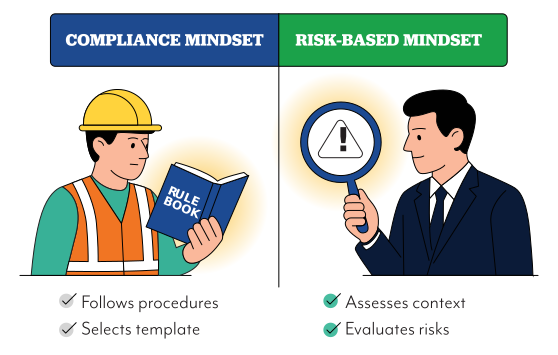
The shift from compliance to risk-based TTM is not a new rulebook; it is a new way of thinking. It moves accountability from a set of diagrams to the quality of an organisation’s decisions.
For Officers, this is a shift. It demands courage to stop accepting “compliance” as an answer. It requires curiosity to ask “why” and “how do you know?” And it requires a focus on building a resilient system where competent people, guided by clear incentives, can make defensible decisions. That is the core of good TTM governance.
Appendices and Tools
Appendix A: Cyclical Governance Agenda Topics
This provides key topics for the Board (or its relevant committee) to sequence on its forward agenda. This ensures all aspects of Officer due diligence are covered over a 12- to 18-month cycle, anchored to the IoD’s “what you need” (Foundations) and “what you do” (Principles) framework.
Foundational Reviews (Annual Cycle)
Risk Appetite and Competing Objectives.
Review and re-approve the Risk Appetite Statement(s) [with deliberate attention and discussion given to TTM] (Part C).Officer and Advisor Capability.
Review the Board's access to competent, independent advice, specifically regarding the discipline of TTM (IoD Principle: Learn and Develop).Commercial and Procurement Guardrails.
Review the effectiveness of the procurement guardrails (Part D).Verification & Learning (12-18 Month Cycle)
Critical Risk Deep Dive.
Commission and receive a deep-dive report on a single, critical TTM risk (IoD Principle: Anticipate and Understand).Assurance Programme Effectiveness.
Review the quality and focus of the TTM assurance programme (IoD Principle: Trust and Verify).Systemic Learning Review.
Review a summary of TTM learnings (IoD Principle: Monitor and Respond).Appendix B: Officer Self-Assessment Tool (Adapted from IoD)
This tool adapts the IoD’s individual review questions to provide a specific TTM governance lens. It is intended to help Officers assess their own behaviours and identify gaps in their due diligence practice against the 5Cs.
TTM Governance Self-Assessment Questions
The 5Cs
IoD Self-Assessment Question (Example)
TTM Governance Lens for Officers
Principle
Governance Intent
Example Procurement Evaluation Criteria
Where this is not practicable, a formal conflict-of-interest management plan that includes independent, third-party review.
Examples of past TTM Design Rationales (see Appendix D) are requested and assessed during procurement.
Evidence that TTM costs adjust dynamically with PtD-led changes to the work.
Performance metrics are tied to project objectives (like network availability or reduced exposure hours), not just TTM inputs.
Appendix D: Example Templates
These examples illustrate the type of information and frameworks appropriate for board-level governance. They are summaries that should be fed by more detailed operational processes.
Example 1: Strategic TTM Governance RASCI
This high-level RASCI clarifies accountability between the Board and its executive team. It defines who is accountable for the system of TTM governance, which is separate from the project-level RASCIs management uses.
Strategic Activity / Decision
Board (Officer)
CEO (Officer)
Executive Team
Independent Assurance (3rd Line)
Example 2: TTM Decision Paper (Governor’s Summary)
This is an example of a one-page summary for the board or a committee, requested for a TTM decision with significant strategic, financial, or reputational implications. It focuses on the trade-offs and justification, not the operational details.
Project: State Highway X – Bridge Deck Replacement
Decision: Select TTM methodology for 12-week main works programme.
Objectives in Tension:
- Safety: Risk of vehicle incursion into a large, static worksite.
- Project Achievement: Requires 12 weeks of uninterrupted work.
- Network Utility: SHX is a critical freight route with no viable detour (< 50km).
Prevention through Design (PtD) Options Considered:
- Full Closure (12 weeks). Rejected. Disproportionate network and economic impact (est. >$30M). Not reasonably practicable.
- Prefabrication Off-site. Partially Adopted. Reduces on-site time from 20 weeks to 12.
Table 1: Basic options table (example only)
Option
Safety (ALARP)
Project (Time/Cost)
Network (Delay)
Recommendation & Rationale (Lowest Total Risk)
- Option C: Single-Lane w/ Signals + Barriers. This option is recommended as it demonstrably achieves the lowest total risk.
- It provides the highest level of safety (Good) by using positive protection (barriers) to eliminate the critical risk of vehicle incursion.
- Crucially, it also delivers the best project outcome (Excellent) by creating a full, separated lane for the work area. This significantly improves project efficiency, safety, and work quality, avoiding the constraints of Option B.
- The Medium network delay from signal queuing is considered an acceptable and manageable trade-off for the significant, verifiable gains in both worker safety and project efficiency..
Residual Risks Accepted by Management
- Medium network delay and queuing during peak flows (to be managed with signal phasing).
- Risks associated with the installation and removal of the barrier and signal systems (to be managed via a specific, short-term plan, e.g., night closure).
Appendix E: Assurance Pack
This appendix provides some tools for Officers or Senior Managers to lean into the assurance process (Part E).
Audit Guide: Key Questions for Outcome-Focused Reviews
This guide helps Officers/senior managers set the expectation for their assurance function (internal or external).
Instead of asking this (Compliance):
Ask this (Effectiveness & Outcome):
Measures that Matter (A Sample for Governors)
This indicator list provides a strategic overview of TTM system health. It is designed to help Officers exercise due diligence by focusing on the effectiveness of the systems that enable safe work, rather than isolated operational metrics. This aligns with IoD guidance to seek assurance on the conditions for success and the quality of the organisation’s learning loops.
Transitional System Health Indicators (Lead)
*Measures the health of our key strategic systems during the transition to risk-based TTM
- Commercial Guardrail Effectiveness
- % of total TTM spend procured via unconflicted design (Part D).
- Risk-Based Procurement
- % of TTM contracts awarded based on risk-based capability and evidence.
- Competence System Maturity
- % of critical roles (e.g., TTM Designer, TTM Reviewer) assured as competent through internal verification (e.g., portfolio review) vs. relying only on external “tickets”.
Control & Learning Effectiveness (Current)
*Measures how our systems are performing and learning
- Prevention through Design Effectiveness (Design System)
- Portfolio-wide trend in planned worker exposure hours (showing if PtD is successfully designing out risk at the source).
- Assurance System Quality (Assurance)
- % of assurance audits that identified critical control failures (e.g., ineffective isolation) – this measures the health of the assurance system, not just the site.
- Learning Loop Quality (Learning)
- Ratio of TTM near-misses closed with systemic actions (e.g., “changed design standard”) vs. local/individual actions (e.g., “briefed worker”).
Strategic Outcomes (Lag)
*Measures the high-level results of our overall strategy
- Health and Safety
- High-Potential Incident / Serious Harm Rate (TTM-related).
- Project & Network Objectives
- TTM-related project cost and schedule overruns (trended over time).
- Public complaints (TTM-related) as a proxy for network utility.
- Financial (Waste Reduction)
- Net cost of TTM (as % of total project cost, trended over time).
Note: this may need to be normalised against complexity, trade off between work/TTM cost, or the degree of risk on projects so it does not become a blanket proportionality assessment which may be misleading).